

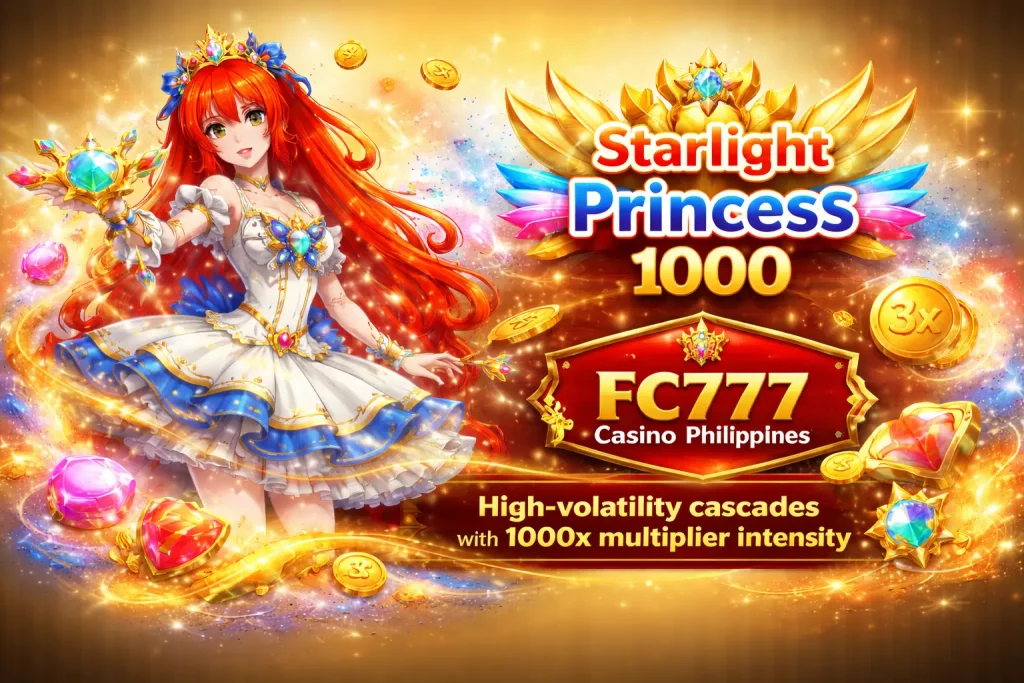
Starlight Princess 1000 — core structure and probability model
Starlight Princess 1000 is built around a multiplier-driven slot model where outcomes are resolved independently on each spin. The game does not carry over state from previous results, and it does not adjust future outcomes based on session history. This means that visible sequences — whether quiet or active — are not signals of change inside the system. Each spin is determined separately through an RNG process, which operates without memory and without compensation logic.
The multiplier mechanic sits at the centre of the experience, but it should be understood as part of the event structure rather than a progression system. Multipliers do not accumulate across spins, and they do not build toward a guaranteed outcome. When they appear, they apply within the boundaries of that specific event cycle. This creates moments of intensity, but those moments are not predictable or influenced by previous spins.
RTP represents a long-term statistical model that becomes relevant only across a large number of spins. In shorter sessions, the observed return can differ significantly from this theoretical value due to variance. Volatility in Starlight Princess 1000 defines how outcomes are distributed over time — some sessions may feel inactive for extended periods, while others may show clustered activity through multiplier interaction. Both scenarios are consistent with the same underlying model.
Demo mode allows players to observe how multipliers appear, how symbols interact, and how pacing feels without financial exposure. It is useful for understanding structure, especially in a multiplier-based slot where visual feedback can be misleading in short sessions. However, demo play does not provide predictive insight into real-money outcomes. The logic remains identical, but perception changes once stake is introduced.
Game structure overview
Game structure overview
| Component | Core Logic | Interaction | Behaviour |
|---|---|---|---|
| Multiplier system | Event-based boost | Triggered | High impact |
| RNG engine | Independent outcomes | No control | Memoryless |
| RTP model | Long-term return | Session mismatch | Variance driven |
| Volatility | Wide dispersion | Swing perception | Clustered results |
| Demo mode | Mechanic exploration | Accessible | No prediction |
Multiplier system and feature flow in Starlight Princess 1000
Starlight Princess 1000 is centred around a multiplier-based mechanic that reshapes how outcomes are perceived during a session. The multiplier does not function as a progression system and does not accumulate across spins. Instead, it appears within specific event windows and applies only when a valid combination aligns with the feature condition. This is important because it separates visual intensity from actual probability behaviour. A visible multiplier does not imply continuation, and its absence does not indicate that one is “due” to appear.
The feature layer is designed to interrupt the base rhythm rather than replace it. Most spins resolve without significant escalation, maintaining a relatively stable baseline. When multipliers appear, they create short bursts of activity that can feel disproportionately impactful compared to the rest of the session. This contrast is intentional. It shapes engagement but does not alter the independence of each spin. The system does not build toward a trigger, and it does not adjust frequency based on prior inactivity.
From a structural perspective, multiplier visibility is one of the key drivers of perceived volatility. Players often associate these moments with turning points in the session, but mathematically they remain isolated events. The spacing between multiplier appearances can vary significantly, and this irregularity is part of the distribution model. Two sessions with similar duration can present completely different multiplier behaviour without deviating from the same underlying logic.
How multiplier visibility shapes session perception
The presence of multipliers increases visual contrast and makes certain spins stand out more clearly. This can lead to a perception that the game has entered a more “active” phase. In reality, the system remains unchanged. The multiplier does not trigger additional opportunities beyond its own event window, and it does not influence the probability of future spins. The perceived shift in momentum is a result of presentation rather than a change in underlying mechanics.
This distinction becomes especially relevant in short sessions, where a single multiplier event can define the entire experience. In mobile play, where sessions are often brief, this effect is amplified. A player may interpret a session as positive or negative based on one or two visible events, even though the system itself has not deviated from its expected behaviour.
Multiplier activity bands
Multiplier activity bands
This chart maps how Starlight Princess 1000 can feel across the base layer, feature trigger layer, and visible multiplier layer. It does not show profit, growth, or return progression. It only helps explain why some sessions feel flatter while others feel more animated inside the same independent probability model.
Reading multiplier behaviour without pattern bias
The key point in Starlight Princess 1000 is that multipliers create moments, not trends. They are designed to be visually distinct and to introduce contrast within the session, but they do not establish a direction or trajectory. A session with multiple visible multiplier events is not “progressing,” and a session without them is not “falling behind.” Both are valid outcomes within the same probability space.
Understanding this helps reduce pattern bias, especially in environments where sessions are short and decisions are made quickly. Instead of trying to interpret when a multiplier might appear, it is more accurate to view each spin as an isolated event with its own outcome, independent from everything that came before it.
Session behaviour and volatility reading in Starlight Princess 1000
Starlight Princess 1000 becomes clearer when the session is read as a distribution model rather than as a story with momentum. In practice, many players react to the multiplier mechanic as if it marks a shift in state, especially after a quiet stretch. The slot does not work that way. A multiplier event can appear after inactivity, or it can remain absent for a long sequence, without either situation implying that the game is moving toward a correction. Each spin is still resolved independently, and the session remains a collection of separate outcomes rather than a connected progression.
This matters because volatility in a multiplier slot is often felt more emotionally than in flatter game structures. Quiet stretches can feel heavier, while a single visible event can dominate the memory of the session. That does not mean the session has become more predictable. It simply means the contrast between ordinary spins and feature-enhanced moments is stronger. In Starlight Princess 1000, volatility should be understood as the spacing and concentration of outcomes across play, not as a sign that the slot is turning favourable or moving away from its expected model.
The difference between short and long sessions is mostly about what the player is able to observe. In a short session, the multiplier layer can distort perception because one or two visible moments carry too much weight. In a longer session, the player is more likely to see that strong-looking events are still irregular and that RTP remains a long-range concept rather than something visible spin by spin. The game does not become more stable because it has “settled.” It only becomes easier to read because more of the natural dispersion has had time to appear.
Demo mode also changes how this behaviour is interpreted. The underlying structure is the same, but without stake pressure, the player is less likely to overread short-term movement. In real play, the same sequence may feel more meaningful than it actually is. That is why Starlight Princess 1000 should be approached as a product where observation helps with understanding the mechanic, but never with prediction. The slot can be read clearly, yet it cannot be forecast through pattern recognition.
Session model comparison
Session model comparison
| Session Type | Duration Pattern | Perception Layer | Actual Model |
|---|---|---|---|
| Short session | Compressed event window | Multiplier-led memory | High variance visibility |
| Medium session | Mixed pacing exposure | Better rhythm reading | Distribution becomes clearer |
| Long session | Extended dispersion view | Less event distortion | Closer to long-range model |
| Demo play | Exploratory interaction | Lower emotional pressure | Same RNG logic |
| Real play | Stake-linked perception | Short-term overreading | Identical structure |
Reading outcomes without pattern bias
The main analytical mistake in Starlight Princess 1000 is treating multiplier visibility as evidence of direction. A visible event does not mean the slot is entering a stronger phase, and a quiet sequence does not mean the game is preparing to compensate. Both ideas come from pattern bias rather than from the actual structure of the game. Once the slot is read through dispersion instead of narrative momentum, the session becomes easier to interpret.
That is the practical value of understanding volatility properly. It does not tell the player what will happen next, but it explains why different sessions can feel so different while still remaining valid expressions of the same underlying model. In Starlight Princess 1000, the right reading is not “what is the slot about to do,” but “how is variance showing itself across this session.” That framing keeps the page accurate, product-led, and clear.
Practical play layer, bonus framing, and device behaviour in Starlight Princess 1000
Starlight Princess 1000 should be approached as a structured slot product rather than a system that reacts to user behaviour. Stake size, spin speed, and session length do not influence the probability engine or improve the chance of multiplier visibility. What these choices change is the way the session is experienced. A faster rhythm can make volatility feel sharper because more spins are compressed into a shorter period, while a slower pace can make gaps between visible events feel more pronounced. In both cases, the underlying model remains identical: independent spins, no memory, and no compensating behaviour after quiet stretches.
Stake management therefore belongs to the interaction layer, not to the outcome layer. A higher stake does not “unlock” a stronger state in the slot, and a lower stake does not make the game more conservative in mathematical terms. The only real difference is exposure per spin and how quickly the user experiences variance in balance movement. This distinction is especially important in the Philippines-facing mobile environment, where many sessions are short, touch-driven, and influenced by immediate visual feedback. In that context, players can easily confuse pacing with structure, even though the slot itself has not changed its behaviour.
Bonuses at TG777 Casino sit outside the core slot logic. A welcome offer, cashback layer, reload promotion, or promo code affects wallet conditions and eligible play rules, but it does not alter RNG, RTP, or volatility. Starlight Princess 1000 behaves the same way whether the player is in a cash session or in a bonus-linked session. The only change is how activity is tracked and what restrictions apply to bonus funds. That separation matters because it keeps the product framing accurate: the casino environment can modify account conditions, but it does not modify the probability model inside the slot.
Wagering should be understood as a release gate rather than as a challenge mechanic. It measures how much eligible staking volume must be completed before bonus-linked balance can move into withdrawable balance. It is not a tool for improving feature access, and it does not create a preferred way to play the slot. In practical use, this means that a multiplier-heavy session under wagering is still just a session inside the same independent system. The bonus may shape the wallet route, but it does not shape the event route of the game itself.
VIP framing follows the same logic. A VIP program may provide account-level benefits such as cashback, priority service, or promotional access, but it does not improve outcomes in Starlight Princess 1000. VIP status does not change how multipliers appear, how RTP is modelled, or how volatility is expressed during play. For an operator-level page, this distinction is essential. Better account treatment is not the same thing as better mathematical conditions inside the slot.
Device behaviour also influences perception. On desktop, players usually have a steadier viewing field and often stay in a session longer, which makes dispersion easier to observe over time. On mobile, the pace is usually faster and more fragmented. Touch input, shorter attention windows, and stronger focus on instant feedback can make multiplier events feel more decisive than they really are. The interface may be optimised differently across devices, but those UX differences do not alter the underlying structure of the game. They only affect how clearly that structure is perceived.
A more responsible way to frame Starlight Princess 1000 is to treat it as a probability-driven entertainment product with a strong visual contrast model. The player can control session length, stake exposure, and whether they are using bonus conditions, but not the outcome engine itself. That is why the clearest way to use the slot is with defined expectations: short sessions can be visually intense without being representative, multiplier moments can stand out without being predictive, and bonuses can add wallet rules without changing the game logic. This keeps the page accurate, product-first, and aligned with how the slot actually works.


